Think Before You Prompt
Why low-effort AI use is quietly eroding your ability to think, and what to do about it.
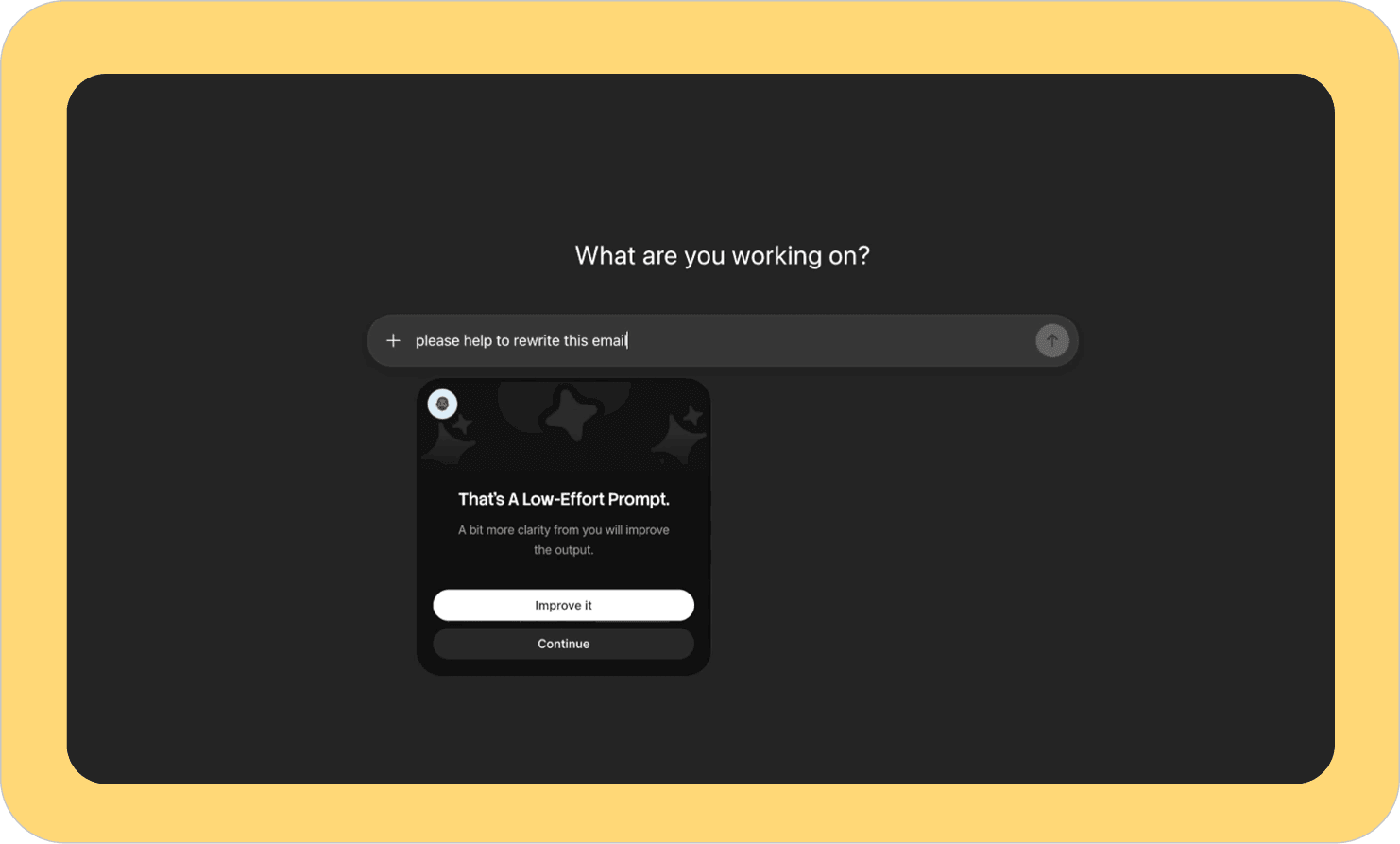
If you find yourself typing "rewrite this" or "make it better" before you've tried yourself, you're not using AI as a tool; you're using it as a replacement for thinking.
That's a subtle but important distinction. And it's one that most productivity writing ignores entirely.
What is a low-effort AI prompt?
A low-effort prompt is one that asks an AI to do cognitive work you could, and arguably should, do yourself. Common examples:
- "Rewrite this paragraph" (before attempting the rewrite)
- "Make this better" (without specifying what "better" means)
- "Give me ideas for X" (before spending five minutes thinking yourself)
- "Summarise this article" (instead of reading it)
- "Write an email saying Y" (when Y could be expressed in two sentences)
None of these are wrong in isolation. AI is a genuinely useful tool. The problem is the pattern: the reflex to offload before engaging, the habit of reaching for AI the moment thinking feels difficult.
That friction, the moment where thinking gets hard, is exactly where cognitive growth happens.
The cognitive offloading trap
Cognitive offloading is the practice of using external tools to handle mental tasks: writing lists, using GPS, asking someone else. It's entirely normal and often useful. The problem arises when offloading becomes the default for tasks that would benefit from your own engagement.
A 2025 study from Microsoft Research and Carnegie Mellon found that frequent AI use was associated with reduced critical thinking engagement, particularly among users who reported high trust in AI outputs. The researchers described it as a "metacognitive shift": users stopped verifying, stopped questioning, stopped engaging critically with the content in front of them.
Put plainly: the more you outsource your thinking, the less practised your thinking becomes.
This isn't a moral failing. It's a predictable response to friction removal. AI tools are designed to be effortless. When thinking becomes effortless, we think less.
The difference between using AI and outsourcing to AI
The distinction worth drawing is between augmentation and substitution.
Augmentation looks like:
- Drafting your own argument, then asking AI to identify weaknesses
- Writing a rough email, then asking AI to tighten the language
- Researching a topic yourself, then asking AI to surface what you missed
- Attempting a task, getting stuck, then asking for a specific nudge
Substitution looks like:
- Asking AI to do the task before attempting it
- Accepting the first output without critical evaluation
- Using AI for tasks you know how to do but don't want to bother with
- Reaching for AI when you feel bored or uncertain, rather than when you're genuinely stuck
The first pattern keeps you in the loop: cognitively engaged, building judgement, developing taste. The second removes you from the loop entirely.
The 2-minute rule for AI use
Before opening an AI tool for any substantive task, try this:
Spend two minutes attempting the task yourself.
Not until it's finished. Not until it's good. Just two minutes of genuine engagement. Write a rough sentence. Jot down three ideas. Sketch out the structure. Let your brain get started.
After two minutes, you're in a much better position to use AI well:
- You understand what you actually need help with (rather than just "make this better")
- You have a baseline to compare the AI output against
- You've exercised the cognitive muscle the task was meant to develop
- You're a collaborator rather than a passive recipient
This is the thinking behind Think First, a feature in pause.do that detects low-effort prompt patterns and suggests a two-minute attempt before continuing. It doesn't block anything. It inserts a moment of reconsideration.
What intentional AI use looks like
Intentional AI use isn't about using AI less. It's about using it with more awareness.
It means noticing when you're reaching for AI out of habit versus genuine need. It means maintaining the ability to evaluate AI outputs critically, which requires you to still know how to think through the problem yourself. It means treating AI as a collaborator that amplifies your thinking, not as a shortcut that replaces it.
The tools you use shape your habits. The habits shape your capabilities. And the capabilities you stop practising are the ones that gradually fade.
Two minutes. Before the next prompt. That's all it takes to stay in the loop.
pause.do is a browser extension that detects low-effort AI prompts and creates a brief moment to reconsider, helping you use AI more intentionally, without restriction. Install free